
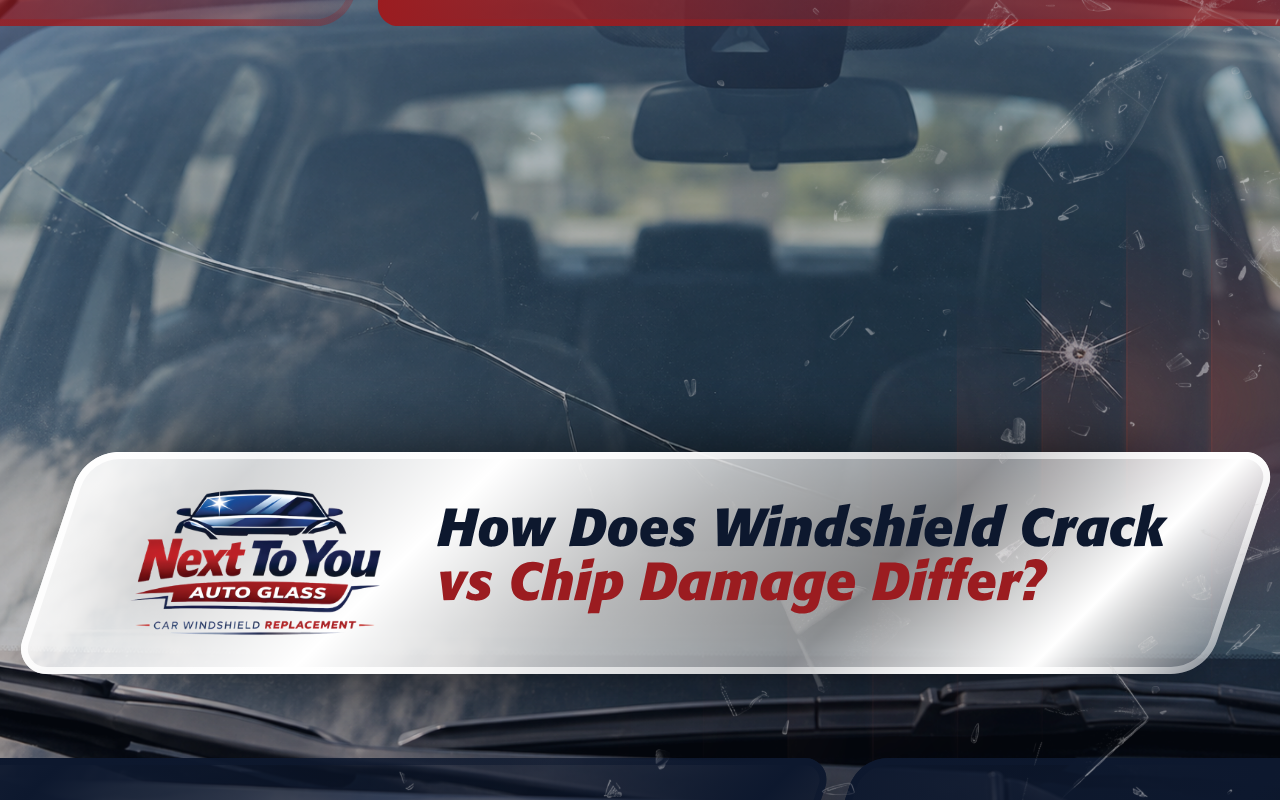
A chip is a concentrated impact mark, while a crack forms a line that can extend through the windshield. Understanding windshield crack vs chip damage helps drivers recognize urgency, but appearance alone does not determine repairability.
Size, depth, location, age, and contamination must also be evaluated. At Next To You Auto Glass, we inspect the complete damaged area before recommending repair or replacement. For professional guidance, explore our auto glass services.
Visual Differences Between Windshield Chips and Cracks
A windshield chip usually appears as a small pit, circle, star, or combination mark. It forms when debris strikes a concentrated area of the outer glass layer.
A windshield crack appears as a straight, curved, or branching line. Some begin at an existing chip, while others start near the glass edge after impact or stress. A small chip may need prompt attention, while a short crack could create bigger concerns near the windshield edge or driver’s viewing area.
| Damage Factor | Windshield Chip | Windshield Crack | Why It Matters |
|---|---|---|---|
| Appearance | Localized pit or impact mark | Straight, curved, or branching line | Shape helps identify the damage category |
| Common cause | Direct impact from road debris | Impact, pressure, stress, or spreading damage | The cause may affect the damaged layers |
| Spreading risk | May develop lines from the impact point | May extend across the windshield | Temperature and vibration can worsen damage |
| Repair potential | Often favorable when small and clean | Depends on length, depth, and location | A technician should evaluate the complete area |
| Replacement concern | Deep, complex, or vision-blocking damage | Edge, extensive, or obstructive damage | Safety matters more than cosmetic appearance |
Windshield Pit vs Chip Damage Is Not Always the Same
A windshield pit is often a shallow surface mark caused by small debris impact. A chip usually has more visible impact structure, such as a pit with a circular, star, or combination pattern around it.
The difference matters because a shallow pit may not need the same service as a chip with small fractures. However, drivers should not rely only on appearance. Dirt, depth, glass layer involvement, and location can change the recommendation.
Common Windshield Chip Patterns Drivers May Notice
Chips do not all look alike. Their pattern can help a technician understand how the impact affected the glass and whether small fractures extend beyond the visible center.
Common Chip Types
- Bull’s-eye chip: A circular mark surrounding a central impact point
- Star chip: Several short lines extending from the center
- Combination chip: Features of circular and star-shaped damage
- Surface pit: A shallow mark that may not penetrate deeply
Dirt, water, or glass cleaner can enter the opening over time. Early evaluation may preserve more repair options and help prevent contamination from affecting the final result.
Types of Windshield Cracks and Their Locations
Cracks may originate at an impact point, along the edge, or within a stressed area. Their direction and location can matter as much as their visible length.
Common Crack Types
- Line crack: A single straight or curved fracture
- Edge crack windshield damage: Damage beginning near the windshield border
- Stress crack: A fracture without an obvious impact point
- Branching crack: Multiple lines spreading from one area
Edge damage deserves prompt evaluation because the perimeter contributes to windshield support. If a crack is spreading or affecting visibility, request your damage inspection before regular driving worsens it.
Can a Chip Turn Into a Crack?
Yes, a chip can turn into a crack when stress spreads from the original impact point. Temperature changes, road vibration, potholes, pressure, moisture, and another impact can all make damaged glass less stable.
This does not mean every chip will spread immediately. Still, waiting can allow contamination inside the break, which may reduce repair quality. A prompt inspection helps determine whether chip vs crack windshield repair is still possible.
Repair Factors That Determine the Safest Option
No single measurement determines whether damage can be repaired. A technician should inspect its size, depth, location, pattern, age, and contamination before making a recommendation.
Repair Decision Factors
- Whether the damage reaches multiple glass layers
- Its distance from the windshield edge
- Whether it obstructs the driver’s viewing area
- The number of chips or connected cracks
- Moisture, dirt, or residue inside the break
- Previous repair attempts around the same location
Repair usually involves removing air and filling the damaged area with specialized resin. This process can improve appearance and help stabilize suitable damage, although the mark may not disappear completely.
When Windshield Damage May Require Replacement
Replacement may be recommended when damage is extensive, reaches the edge, affects several layers, or interferes with safe visibility. Multiple impact points can also reduce the suitability of repair.
The windshield contributes to the vehicle’s overall safety system. Therefore, the repair-versus-replacement decision should not depend only on price or whether the vehicle remains drivable.
Temperature and Vibration Can Worsen Existing Damage
Glass expands and contracts as temperatures change. Sudden heating or cooling can concentrate stress around an existing chip or crack, causing it to spread.
Road vibration, potholes, speed bumps, and forceful door closing can also affect weakened glass. These conditions do not guarantee spreading, but delaying an inspection increases uncertainty.
Visibility Problems Make Windshield Damage More Urgent
Chips and cracks can reflect sunlight, distort lights, and create glare. These effects may become more noticeable at night, during rain, or when driving toward direct sunlight.
Damage within the driver’s primary view may remain distracting even after a structural repair. A technician should consider both glass stability and the expected visual result.
ADAS Calibration After Certain Windshield Replacements
Many newer vehicles have cameras or sensors mounted near the windshield. These components may support lane warnings, automatic braking, traffic-sign recognition, or other driver-assistance features.
When replacement affects camera positioning, the vehicle manufacturer may require calibration. Our team at Next To You Auto Glass checks applicable vehicle requirements instead of assuming every replacement follows the same procedure.
Mistakes to Avoid After Discovering Windshield Damage
- Ignoring a small chip because it does not block visibility
- Using household glue or improvised repair materials
- Blasting hot air directly onto cold damaged glass
- Allowing water and dirt to remain inside the break
- Assuming every short crack qualifies for repair
- Delaying service until the damage reaches an edge
Frequently Asked Questions About Windshield Glass Damage
What is the main difference between a chip and crack?
A chip is a concentrated impact mark or pit. A crack is a line that extends through the glass and may continue spreading under stress.
Can a small windshield chip turn into a crack?
Yes. Temperature changes, vibration, moisture, or another impact can cause fractures to spread from an existing chip.
Can every short windshield crack be safely repaired?
No. Repairability also depends on depth, location, edge proximity, contamination, visibility, and the number of damaged areas.
What is the difference between a windshield pit and chip?
A pit is usually a shallow surface mark. A chip often includes a more defined impact pattern and may have small fractures around it.
When should windshield glass receive prompt replacement?
Prompt evaluation is important when damage affects visibility, reaches an edge, spreads, penetrates deeply, or involves several connected areas.
Choose the Right Response Before the Damage Spreads
Comparing windshield chip vs crack damage provides a useful starting point, but only a complete inspection can determine the appropriate service. Our team at Next To You Auto Glass evaluates the damage and explains whether repair or replacement better fits the windshield’s condition.
Avoid waiting for a small mark to become a larger visibility problem. To receive a condition-based recommendation, schedule your glass evaluation.