When Is ADAS Calibration Needed After Windshield Replacement?
ADAS calibration after windshield replacement may be required when a forward-facing camera is removed, repositioned, or mounted behind the new glass. Calibration restores the camera’s specified aiming so features such as lane departure warning and forward collision assistance can interpret road information correctly.
The exact requirement depends on the vehicle manufacturer, model, installed safety systems, glass specifications, and repair procedure. An illuminated warning light is not the only reason to check calibration. Some vehicles may store diagnostic trouble codes or disable features without displaying an obvious dashboard warning.
At Next To You Auto Glass, we help drivers understand their windshield replacement and calibration needs. Our team provides mobile auto glass support for drivers in Los Angeles, Orange County, and nearby areas. Explore our professional auto glass services before scheduling your next step.
Why Windshield Replacement Can Affect ADAS Cameras
Many vehicles position a forward-facing camera near the rearview mirror. The camera views the road through a specific area of the windshield. Replacing the glass may involve removing the camera, transferring related components, or changing its relationship to the road.
A small alignment difference may affect how the system reads lane markings, nearby vehicles, road signs, or other visual information. Correct glass selection and camera bracket placement are therefore important parts of the replacement process.
Systems That May Be Affected
- Lane departure warning
- Lane-keeping assistance
- Forward collision warning
- Automatic emergency braking
- Adaptive cruise control on certain models
- Traffic sign recognition
- Automatic high-beam assistance
What Windshield Camera Calibration Actually Does
Windshield camera calibration establishes the camera’s required reference position. The process allows the vehicle to interpret the camera’s view according to manufacturer specifications instead of assuming the camera is already aligned.
This matters because modern driver-assistance systems rely on precise inputs. If the camera angle is slightly off, features like lane assist calibration, collision alerts, and road-sign recognition may not respond as intended.
A technician may also perform a diagnostic scan before or after calibration. Scanning can identify stored fault codes, communication problems, or conditions that must be corrected before the calibration routine can succeed.
Compare Static, Dynamic, and Dual ADAS Calibration
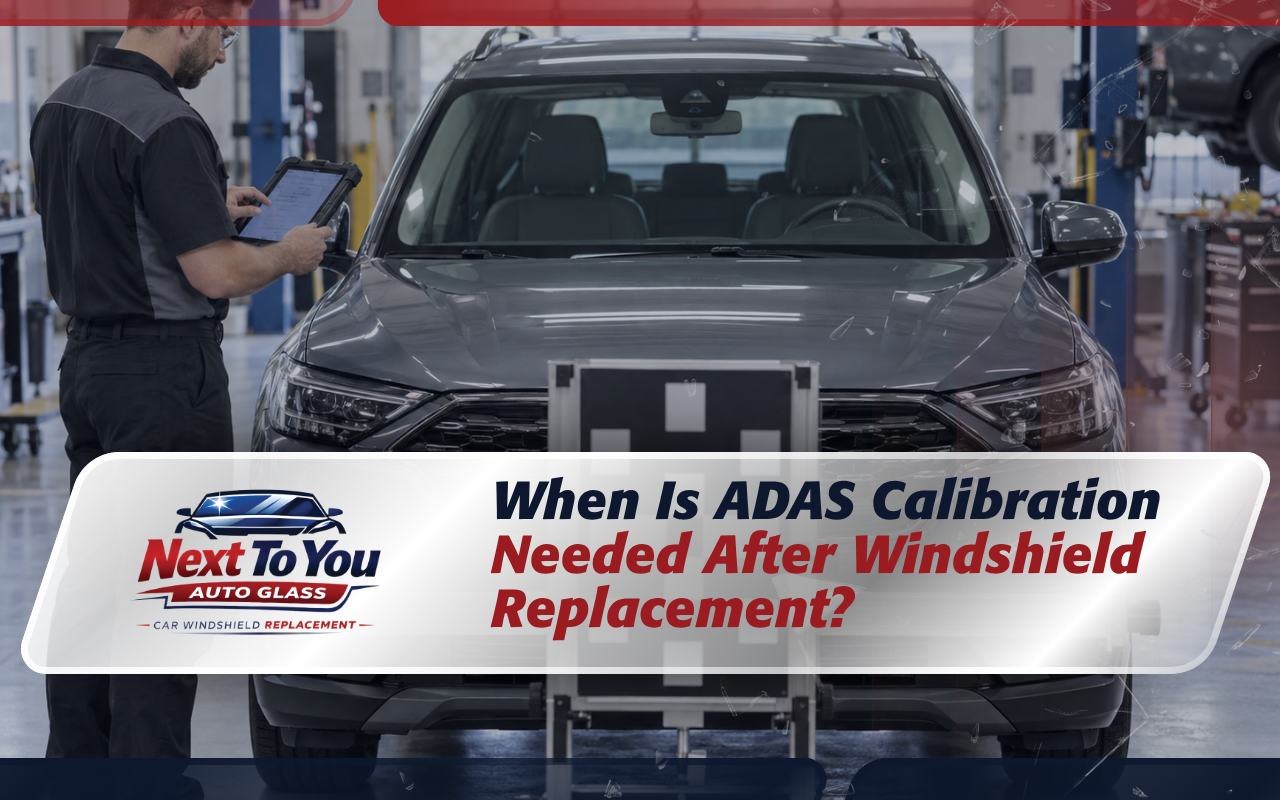
ADAS recalibration is not the same for every vehicle. Some models require stationary target setup, some require a road-driving procedure, and others require both. The correct method depends on the manufacturer’s service information.
ADAS Calibration Method Comparison
| Calibration Method | How It Generally Works | Important Requirement |
|---|---|---|
| Static calibration | Uses targets positioned around a stationary vehicle. | Controlled space, measurements, lighting, and equipment. |
| Dynamic calibration | Uses a scan tool while driving under specified conditions. | Appropriate roads, speeds, visibility, and traffic conditions. |
| Dual calibration | Combines static and dynamic procedures. | Both procedures must meet vehicle-specific instructions. |
Key Takeaway
ADAS windshield calibration should follow the exact procedure required for the vehicle, not a generic reset or online shortcut.
How ADAS Recalibration Is Completed After Glass Replacement
The process begins by identifying the vehicle and reviewing its required service information. A technician confirms the glass type, camera mounting, tire condition, vehicle load, and other prerequisites specified for that model.
Depending on the vehicle, the technician then performs a static, dynamic, or dual calibration. Diagnostic codes are reviewed, and the system is checked after the procedure.
General Recalibration Steps
- Identify the installed ADAS equipment and manufacturer procedure.
- Inspect the windshield, camera bracket, and camera seating.
- Check required vehicle and workspace conditions.
- Perform the specified static, dynamic, or dual procedure.
- Review diagnostic codes and confirm successful completion.
Schedule ADAS Calibration Support
When Windshield ADAS Calibration May Be Required
Windshield ADAS calibration may be required after the windshield is replaced, the camera is removed, the camera bracket is disturbed, or the vehicle stores ADAS-related fault codes. Some vehicles may also require calibration after certain suspension, alignment, or collision repairs.
Drivers should not rely only on the dashboard. A warning light may appear, but some systems can also limit functions without making the issue obvious. This is why the vehicle should be checked according to its specific requirements.
Situations That Should Be Reviewed
- The windshield was replaced.
- The forward-facing camera was removed or transferred.
- The vehicle shows ADAS warning messages.
- Lane assist or collision features behave inconsistently.
- The camera bracket or glass area was disturbed.
- The vehicle manufacturer requires calibration after service.
What Can Prevent Successful ADAS Camera Calibration?
ADAS camera calibration depends on the vehicle, equipment, glass, camera position, and surrounding conditions. Calibration equipment alone does not guarantee a successful result.
Requirements differ by manufacturer, which is why one universal setup should not be used for every vehicle. The technician must confirm whether the conditions match the procedure before completing the calibration.
Common Calibration Problems
- Incorrect windshield glass or camera bracket placement
- A loose, damaged, or improperly seated camera
- Uneven tire pressure or unsuitable vehicle load
- Poor lighting, glare, or reflective objects during static calibration
- Roads with limited markings or unsuitable driving conditions
- Active diagnostic faults or low vehicle battery voltage
Warning Signs Deserve Diagnosis After Windshield Replacement
An ADAS warning light after replacement should not be ignored. However, a warning does not automatically prove the camera needs replacement. Diagnostic testing may reveal a calibration issue, mounting problem, communication fault, blocked camera view, or unrelated electrical condition.
Other concerns may include unavailable-system messages, inconsistent lane alerts, disabled collision features, or unusual assistance behavior. Drivers should avoid depending on an affected feature until the system has been evaluated.
Signs to Watch For
- ADAS or camera warning light
- Lane assist not working as expected
- Forward collision alerts disabled
- Unavailable-system messages
- Vehicle safety features behaving differently after glass replacement
Why DIY Windshield Camera Recalibration Is Risky
Windshield camera recalibration requires more than placing targets near a vehicle. Target design, distance, height, floor level, lighting, vehicle position, scan-tool functions, and manufacturer procedures must all match the application.
A routine can appear complete while an underlying glass, mounting, or diagnostic problem remains. For that reason, this article does not provide DIY measurements or target-placement instructions. Professional evaluation is the safer choice when safety-related driver-assistance systems are involved.
Why Choose Next To You Auto Glass for ADAS Support?
Next To You Auto Glass helps drivers understand windshield replacement, glass selection, camera mounting, and calibration-related needs. Our team brings 15+ years of experience to mobile auto glass service for Los Angeles, Orange County, and nearby areas.
Because each vehicle has different requirements, we review the vehicle details before recommending the next step. That helps drivers avoid assumptions about windshield calibration and ADAS recalibration needs.
Request Your Service Appointment
Frequently Asked Questions
Does every windshield replacement require ADAS calibration?
No. The requirement depends on whether the vehicle has affected cameras or sensors and what the manufacturer specifies for that repair. The vehicle must be identified before deciding.
Is windshield calibration the same as ADAS recalibration?
The terms are often used interchangeably when the windshield-mounted camera must be restored to the alignment and operating references specified for the vehicle.
How soon should calibration be completed after replacement?
When calibration is required, it should be completed as part of the replacement process before the driver relies on the affected safety features.
Can lane assist calibration be affected by a new windshield?
Yes. If the camera used for lane assist is removed, shifted, or mounted behind new glass, calibration may be required so the system can read lane markings correctly.
Will ADAS calibration remove every dashboard warning light?
Not necessarily. Warning lights can result from mounting, glass, software, voltage, wiring, communication, or sensor problems. Diagnosis should identify the actual cause.
Can weather interfere with dynamic ADAS recalibration?
Yes. Poor visibility, unsuitable road markings, heavy traffic, rain, fog, or other conditions may prevent the vehicle from completing a required driving procedure.
Restore Your Vehicle’s Safety Systems With Proper Calibration
ADAS calibration after windshield replacement is a vehicle-specific procedure, not a universal reset. Correct glass, secure camera mounting, proper diagnostic equipment, suitable conditions, and manufacturer instructions all contribute to a successful result.
At Next To You Auto Glass, we bring 15+ years of experience to auto glass service. If your vehicle needs windshield replacement, camera evaluation, or ADAS recalibration, request your service appointment today.